Industry Insights
LED Message Center vs. Static Sign: Is the Upgrade Worth It?
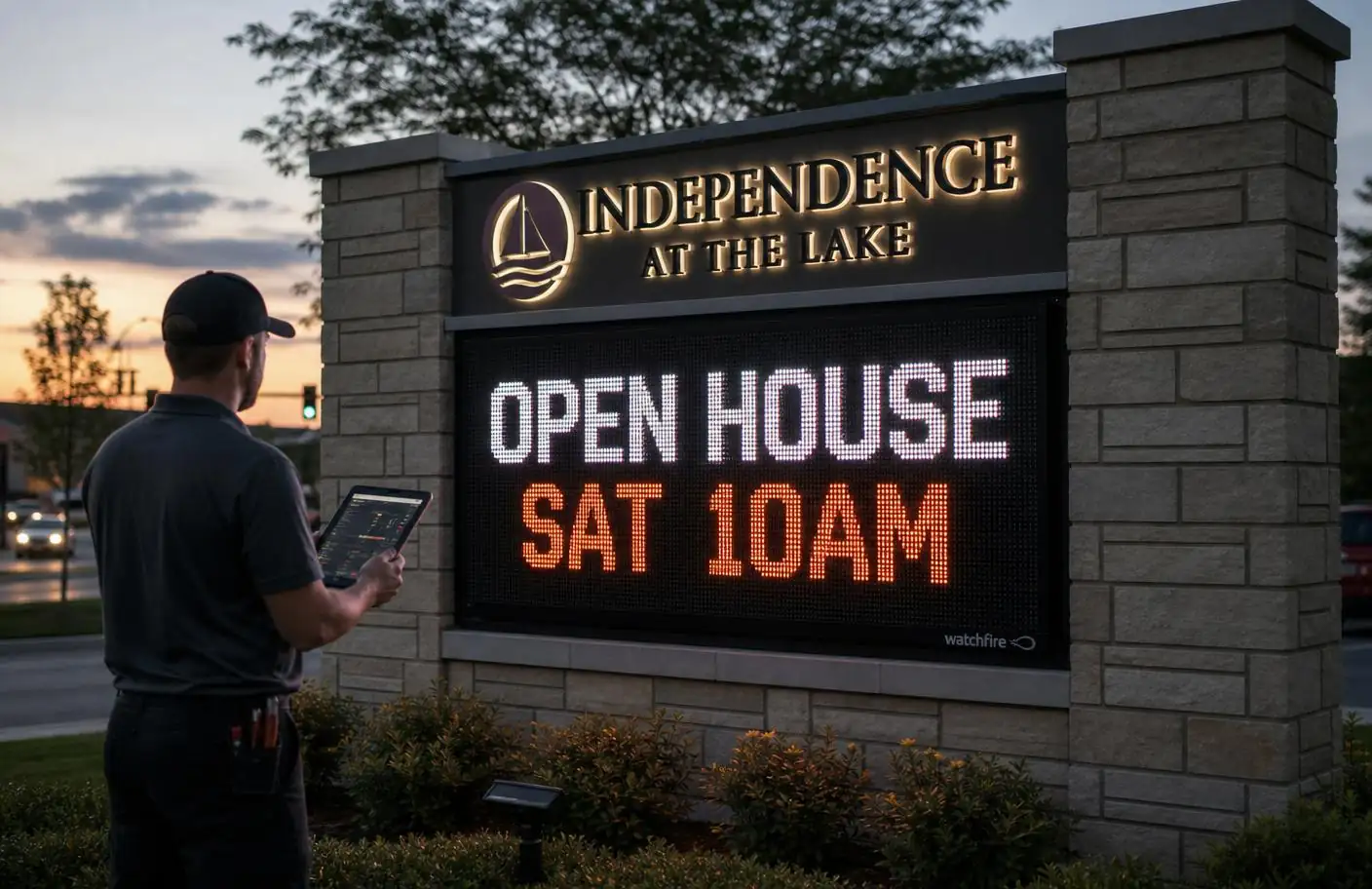
An LED message center costs several times more than a comparably sized static cabinet sign — sometimes far more. That gap is real, and it's fair to ask whether the upgrade actually pays for itself or just looks impressive. The honest answer depends heavily on your business type, how often you'd actually update the message, and how much of your customer traffic is drive-by versus destination.
Here's the breakdown of what an EMC buys you beyond a static sign, and the situations where it clearly does or doesn't justify the cost.
The cost gap in Southwest Washington
- Static illuminated cabinet sign: $4,000 – $9,000 for a small sign
- Small EMC (3x6 ft. single-sided): $12,000 – $22,000
- Standard EMC (4x8 ft. double-sided): $22,000 – $40,000
What an EMC actually buys you
- Content changes in seconds from any browser or phone, instead of a physical panel swap or new faces
- Multiple messages rotating on a schedule — promotions, hours, community messages, sports scores
- Higher attention-grabbing power simply because it's a moving/changing element on an otherwise static streetscape
- The ability to react same-day to a promotion, closure, or urgent message
Who gets the most value from the upgrade
- Businesses with frequent promotions or changing offers (restaurants, retail, fuel/service stations)
- Schools and churches communicating regularly changing event and schedule information
- High-traffic locations where the attention advantage of a changing message has real reach

Who's better served by a static sign
- Businesses whose message essentially never changes — a static logo/name sign does the job without ongoing hardware cost
- Low-traffic locations where the audience for a changing message is small
- Budget-constrained projects where the core need is basic identification, not a marketing channel
The maintenance and lifespan side
EMCs from tier-one brands (Daktronics, Watchfire, Optec) typically carry 5-7 year parts warranties and 10+ year expected life, with real service network support. Static signs have effectively no equivalent maintenance need beyond occasional lamp or LED module service — a real ongoing cost difference to factor into the comparison, not just the upfront price.
A middle path: retrofit an EMC section later
If the budget doesn't support a full EMC now, a common approach is building the sign structure to support adding an EMC panel later — sized and engineered for the added weight and wind load up front, even if the digital section is deferred. It's worth mentioning during design if there's any chance you'll want to upgrade down the road.
Frequently asked questions
- Does an EMC pay for itself in increased business?
- It depends heavily on business type and traffic — a restaurant running frequent promotions sees a clearer case than a business with a message that rarely changes. There's no universal payback number; it's worth weighing against your specific use case.
- Can I add an EMC to an existing static sign structure?
- Often, if the structure can support the added weight and wind load. We assess the existing structure first — sometimes it's a straightforward retrofit, sometimes the structure itself needs reinforcement.
- How much does it cost to run an EMC compared to a static illuminated sign?
- A typical EMC draws more power than a static sign of similar size, but auto-dimming keeps average draw well below peak. It's a real ongoing cost difference, though usually modest compared to the upfront hardware gap.
Talk to ESCO Pacific
Have a sign project in mind?