Guides & Education
LED Message Centers: Sizing, Pricing, and Code Compliance
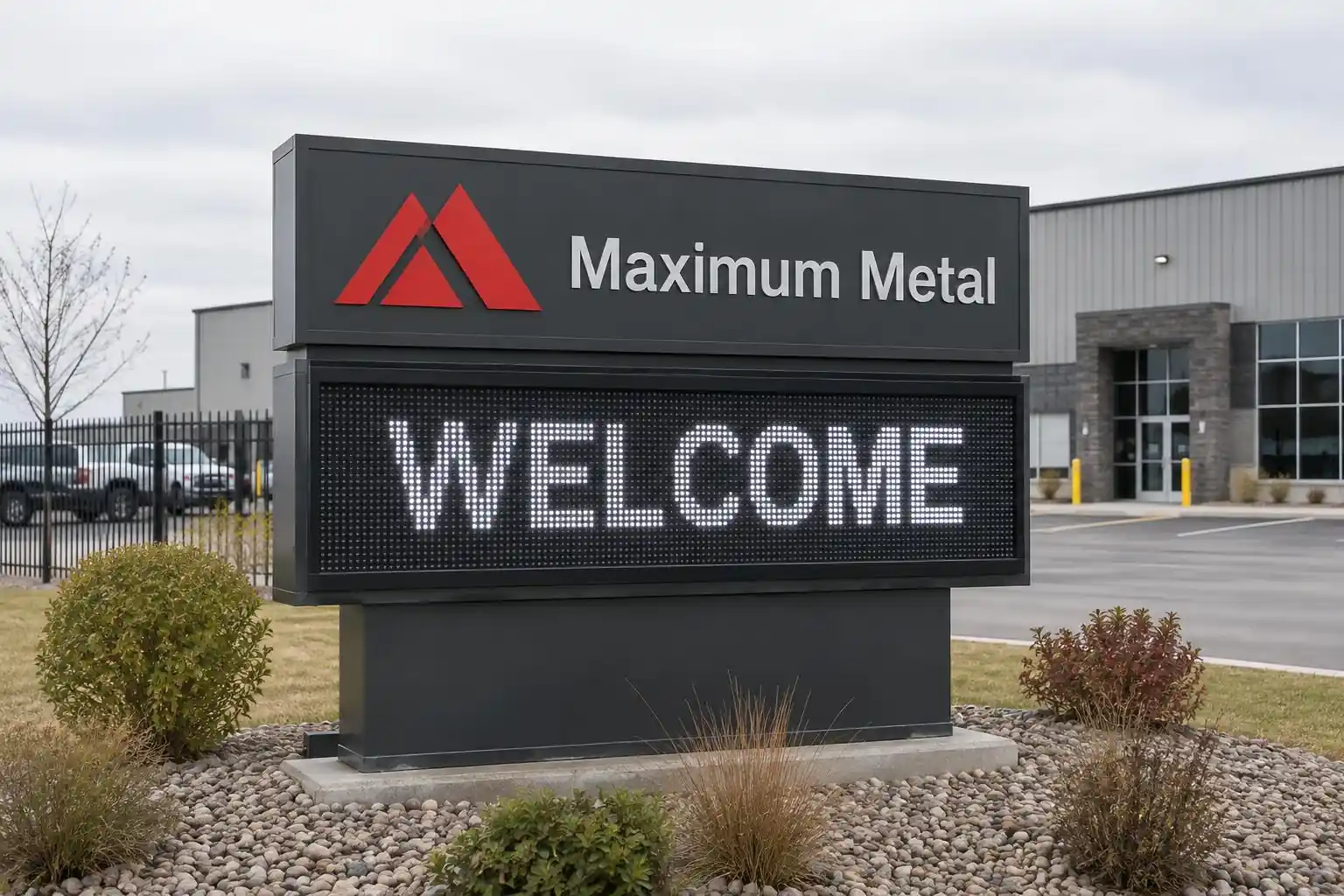
An LED message center (also called an EMC or digital sign) is the highest-attention exterior signage a business can install. Content changes on a schedule, promotions push out in seconds, and the sign works twice as hard as static signage.
But there are four decisions that make or break the investment: pixel pitch, physical size, brightness rating, and the local code that governs how the sign is allowed to operate. Get all four right and you have a 10+ year asset. Get one wrong and you have a very expensive problem.
Pixel pitch — the number that decides everything
Pixel pitch is the distance in millimeters between the center of one LED and the next. Smaller pitch = higher resolution = closer viewing distance possible. Every other spec on the sign flows from this number.
- P10 (10mm pitch): standard outdoor pitch. Minimum viewing distance ~30 feet. Great for road-facing signs at 25+ mph traffic.
- P8: minimum viewing distance ~24 feet. Good compromise for mixed pedestrian and vehicle traffic.
- P6: minimum viewing distance ~18 feet. Premium retail and pedestrian-heavy corridors.
- P4 and finer: only for close-range pedestrian viewing or indoor use.
Physical sizing rules
There's a straightforward rule of thumb: every 1 inch of character height gets you approximately 50 feet of legibility. A 12-inch character reads at ~600 feet, an 18-inch character reads at ~900 feet, a 24-inch character reads at ~1,200 feet.
Match that to your traffic. A driver at 45 mph needs 2 full seconds of read time — about 130 feet of forward travel. Character height and pixel pitch have to hit those targets or your message doesn't land.
Brightness matters more than pixel count
Outdoor EMCs need 6,500 to 8,000 nits to compete with direct sunlight. Anything under 5,000 nits washes out on a sunny day and your message disappears when you most need it.
Every quality sign has an auto-dimming photocell. At night the sign should drop to under 500 nits — bright enough to read, dim enough not to violate local light pollution rules.
The code side (this is where projects die)
- Dwell time: many cities require each message to hold for 8+ seconds before changing. Some require 30+.
- Transition style: static change only (no scrolling, animation, or video) is common. Chehalis and Centralia both restrict animation.
- Brightness cap: measured in nits, often lower for signs near residential zones.
- Sign area counting: in some codes the EMC counts as part of your total signage area, limiting how much other signage you can also have.
- Distance from ROW: setback requirements often apply to freestanding EMC-topped signs.
Realistic pricing in Southwest Washington
- Small (3x6 ft. single-sided P10): $12,000 – $22,000
- Standard (4x8 ft. double-sided P10): $22,000 – $40,000
- Larger (5x10 ft. double-sided P8): $40,000 – $75,000
- Full pylon-top EMC (6x14 ft.+ P8/P6): $75,000 – $200,000+
- Add 20–35% for foundation, structural rework, and permitting on freestanding installs
Warranty and service
The brand matters. Daktronics, Watchfire, and Optec dominate the U.S. market — 5-to-7-year parts warranties, 10+ year expected life, and a real service network. Off-brand imports save 30% up front and cost you more than the savings by year four.
Every ESCO Pacific LED install includes remote content management setup so you or your staff can push messages from any browser or phone.
Frequently asked questions
- Can I control the sign remotely?
- Yes. Every EMC we install comes with cloud-based content management — schedule messages, push emergency alerts, and update from any device with a browser.
- How much power does an LED sign use?
- A typical 4x8 ft. outdoor EMC draws 1,500–3,000 watts at full brightness — comparable to a small kitchen appliance. With auto-dimming, real average draw is far lower.
- Can I add an EMC to my existing sign?
- Often, yes. If the existing structure can support the added weight and wind load, we retrofit an EMC section into (or on top of) the current cabinet. We assess structural first.
Talk to ESCO Pacific
Have a sign project in mind?